Show your work
Highlight, annotate, and move a visible agent cursor so users see what the system is about to do before it does it.
For developers shipping agentic products
This runtime connects models to real interfaces with overlays, relay-backed sessions, MCP tools, browser runtime support, and desktop accessibility hooks so agents can point, narrate, act, and verify.
Why this exists
Highlight, annotate, and move a visible agent cursor so users see what the system is about to do before it does it.
Use a relay, SDKs, and MCP tools instead of ad hoc glue code every time you want an agent to touch a live interface.
Pair browser overlays with native accessibility access for desktop workflows that can’t be reduced to webpage automation alone.
The stack
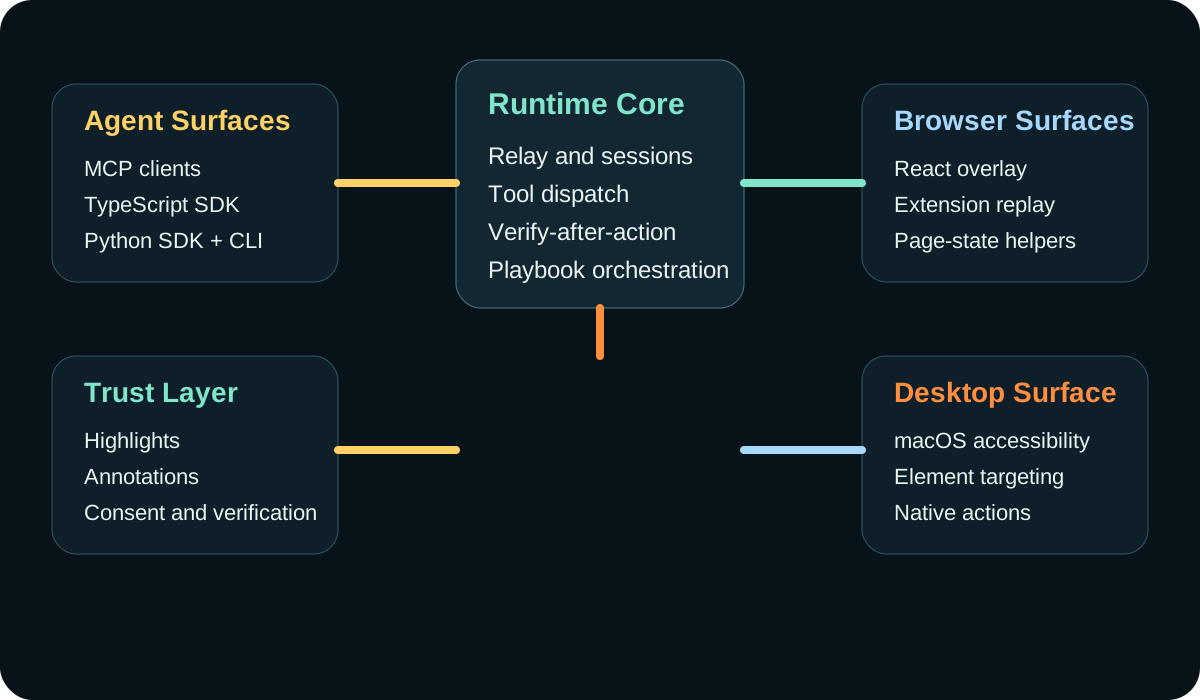
MCP client, TypeScript SDK, Python SDK, CLI, custom WebSocket clients
Relay, tool dispatch, verification, playbook orchestration, session routing
Browser overlay, extension replay runtime, macOS accessibility backend
Structured wire types, session-aware routing, and explicit tool semantics.
Overlays, narration, and verification make agent behavior inspectable.
Use one layer or the full stack: SDK, overlay, extension, MCP, or playbook engine.
Explore
For teams that want a managed Browserbase-style path to visible agent sessions before self-hosting.
Request a pilotThe relay, tools, overlay, extension, and accessibility path explained in one technical view.
Open architecture pageSupport flows, onboarding, QA, and internal tools where showing intent matters as much as acting.
Open use cases pageThe shortest path from repo clone to a running relay, overlay, and SDK-driven interaction loop.
Open quickstart pageShared content tokens make the future product name, tagline, and CTA language easy to swap.
Open marketing READMEProof points
The relay, MCP server, playbook engine, browser overlay, extension, TypeScript SDK, Python SDK, and macOS accessibility backend are all present in-repo.
Visual highlighting, narration, replay, verification, and structured tool errors create a better operator experience than blind background automation.
Desktop accessibility is strongest on macOS today; Linux and Windows are promising but not yet the production-default path.
Visual assets
Reusable runtime diagram for docs, marketing pages, and decks.
Starter open-graph style panel for social sharing and repo previews.
Developer feel
import { CoPilotClient } from "@ghostrider/sdk";

const client = new CoPilotClient("ws://127.0.0.1:4201/ws/agent");
await client.connect();

await client.highlight("#submit-btn", { label: "Review this action" });
await client.annotate("#submit-btn", "Submitting after validation");
await client.clear();
import { CoPilotOverlay, CoPilotProvider } from "@ghostrider/overlay";
export function Root() {
return (
);
}import asyncio
from ghostrider import GhostRiderClient
async def main():
async with GhostRiderClient("ws://127.0.0.1:4201/ws/agent") as client:
await client.highlight("#submit-btn", label="Review this action")
await client.annotate("#submit-btn", "Submitting after validation")
await client.clear()
asyncio.run(main())Start here
Keep the technical docs focused on implementation truth, and let this area become the polished front door for developers evaluating the project.